Riffs
Why astrophotography needs a special kind of crazy
February 23, 2026 · 5 min read
I think the best examples to teach with are the ones with the most screw ups. This was one was not a complete disaster but lets say there were problems. I started taking this picture on December 3rd 2025, those perfect winter nights for astrophotography with long, dark evenings and nights, when its still not cold enough in New York for toes and fingers to freeze dry and fall off during polar alignment (separate session on the joys of this some day). As it happens, Winter 2025, still ongoing in late Feb 2026, has turned out to be one the worst winters in New York in a long time. I have gone weeks without being able to take my gear out due to clouds, snow, rain etc and then of course is the joy of living in a suburb with trees everywhere. I happen to love trees in the morning but don't see their point at night! Those who chase this pointless hobby know what I am talking about. There is only a narrow slice of the sky that I get to peek into at night because of all the trees around. In order for me to photograph something interesting, it has to show up in that narrow slice of sky between the trees and then stay there for a long enough period for me to take a couple of hundred pictures (at least). If a couple of weeks go by without pictures due to clouds or snow, well, the object may now have moved behind a tree and a photograph I started can only end next year when the object re-emerges in the same part of the sky. Lets just say this hobby needs patience!
Having lived that rambling preamble, I started taking this picture when I could take 50+ 300 second frames a night without losing the nebula from the telescope's field of view. Then I had to go on vacation (had to! long year!), not that I missed much in cloudy New York. I started again in early January but it was clouds, snow storm, blizzard redoux but I hobbled along undefeated. In between of course, my auto-focusser refused to work and when I somehow managed to fix that (it was, as always, a screw if you must know!), my filter wheel broke down and wouldn't talk to my controller (ASI Air) (forcing me to go manual with filters). I kept going but only to have a bunch of badly focussed images, some with clouds and in this agony, I also managed screw up the exposure time for some nights (180 seconds instead of 300 seconds).
I kept going despite all this but by the middle of Feb I was down to taking just a pathetic 10 frames a night of the Bubble nebula because that is all that the tree in my backyard and the earth's rotation considered appropriate. I finally gave up on this target but it wasn't a bad haul - over 30 hours of exposure which on a monochrome camera is a lot (and also unnecessary) for good quality pictures. The problem of course was that half of this exposure was Hydrogen Alpha (Ha), followed by Sulphur iii (Siii) (~9hours) with 'only' 6 hours of Oxygen ii (Oii). Normally, it would make sense to spend the most time on the faintest signal (Oii in this case) but I started on this filter last because of my metronomic planning (!) by which point, my window was over. So I made do with what I had and this was my final haul:
Ha: 185 x 300s [some 180s if you must know]
0iii: 76 x 300s
Sii: 109 x300s
L: 25 X180s
December 3rd to February 14th.
For those who know, I recognize this ratio of Ha:Siii:Oii makes little sense. But in my defense, I had to make mistakes to make this post worth it! In the normal course, I would have gone for 1:1:2 and in the case of the bubble nebula, i could have gotten away with 1:1:1 (due to stronger oxygen signal). I decided to plod along just to see what i get. This is it.
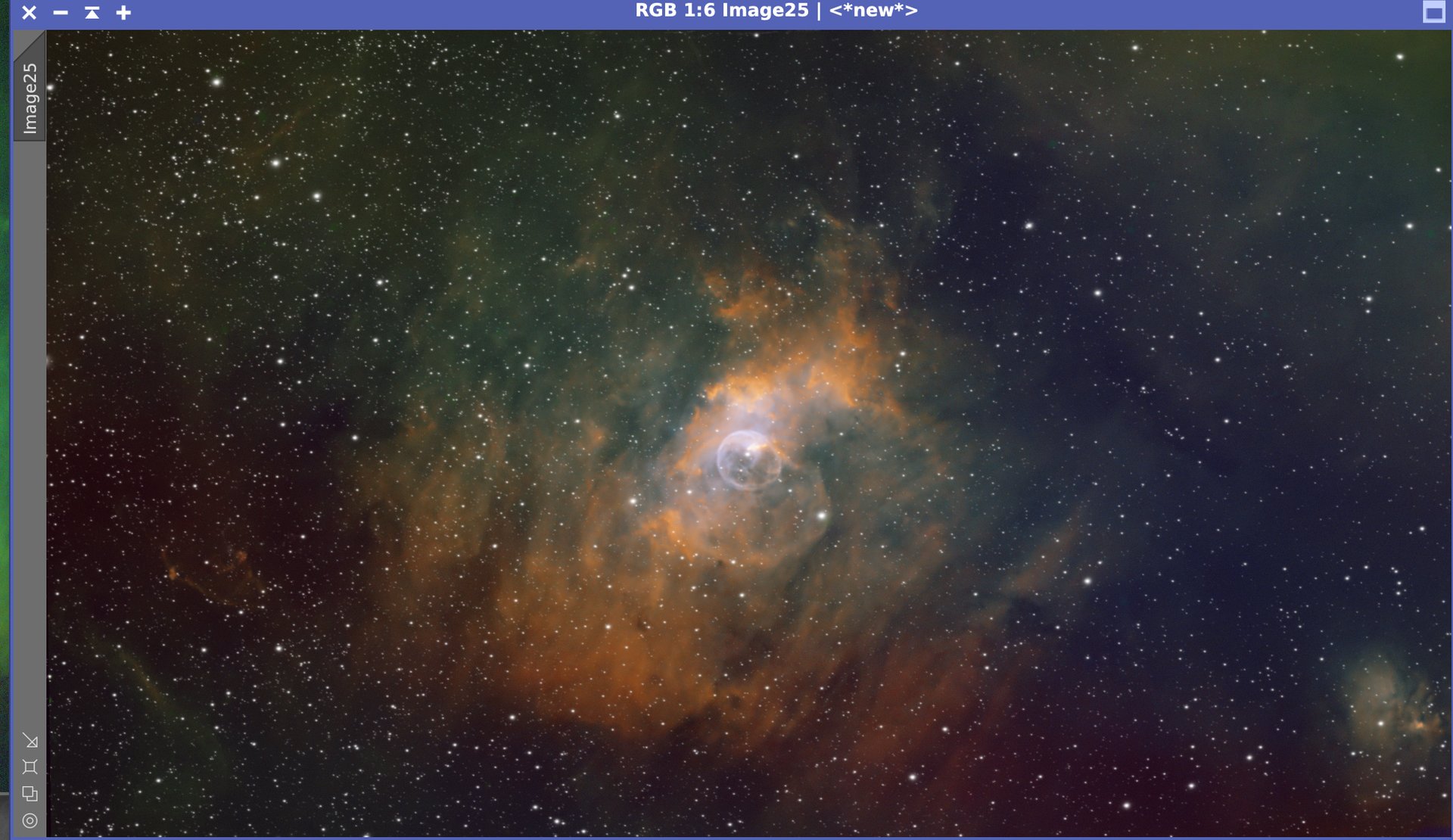
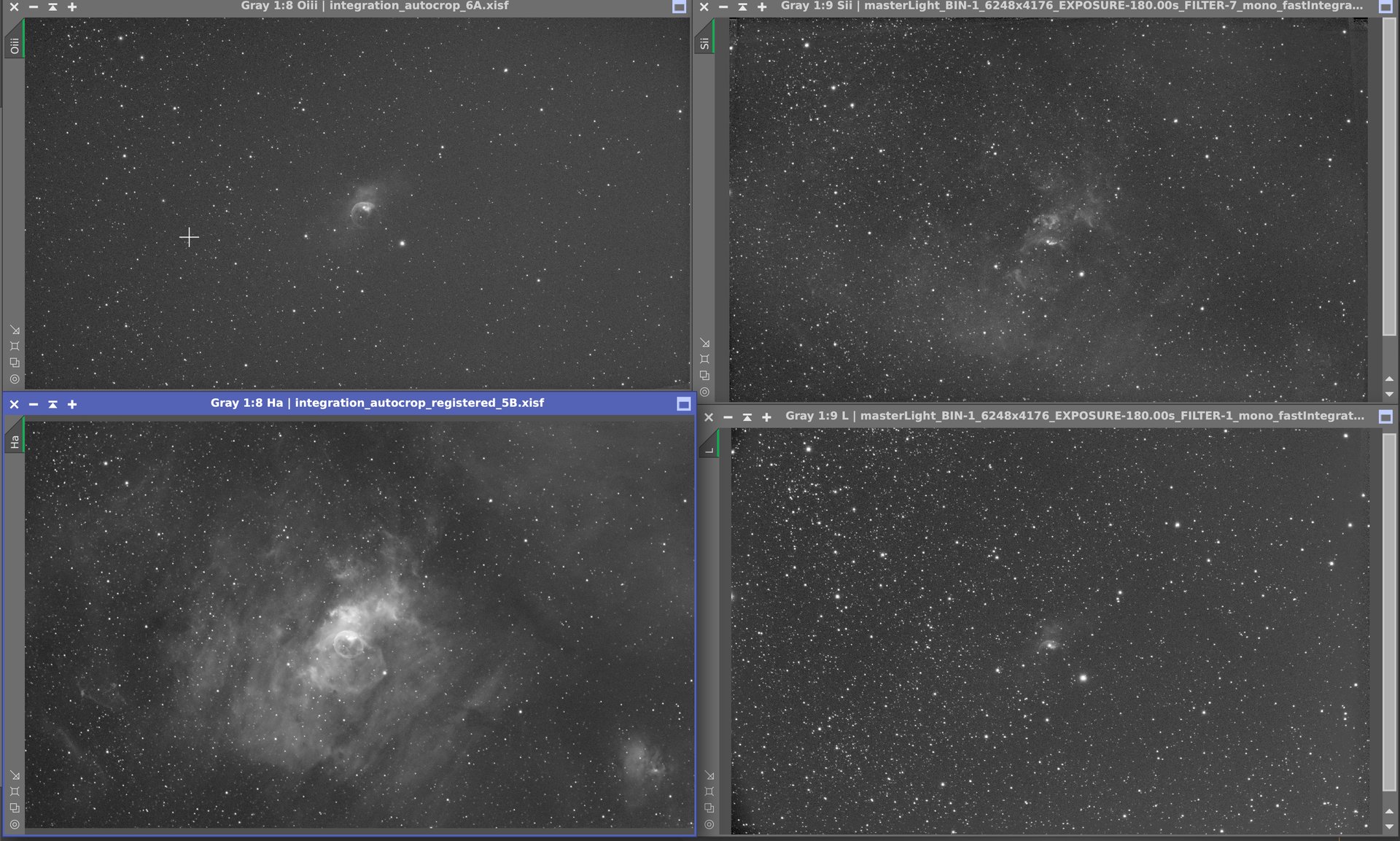
Not bad. I massaged it further by reducing the signal from Ha in LRGB processing in Pixinsight. I also tried processing this through PixelMath [which allows more subtle manipulation] and got the following:
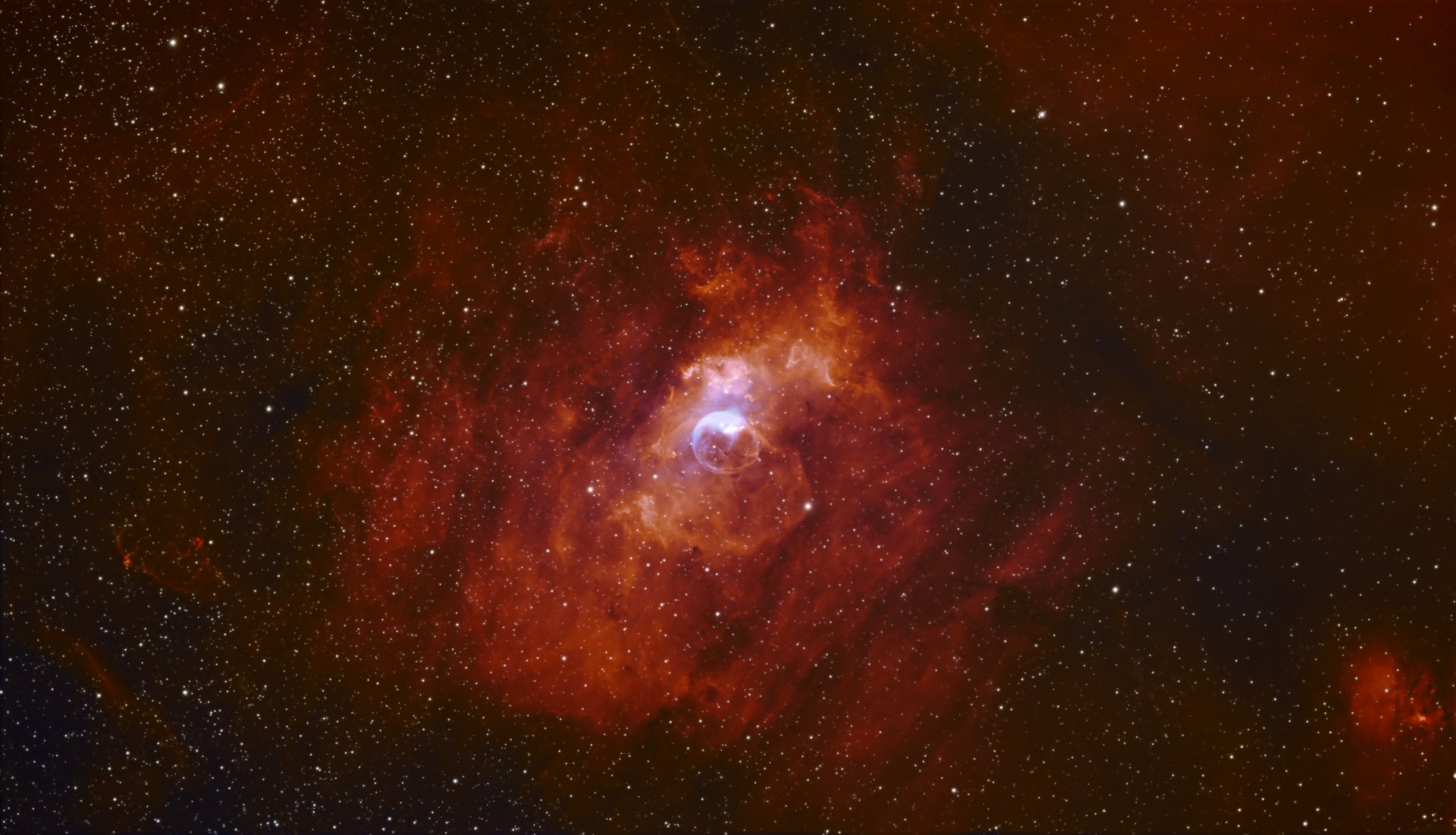
If you said huh?! to mentions of LRGB Combination, PixelMath and Pixinsight, dont worry, I was in the same boat late 2024. Clueless. Didn't know where to start. My saviours on YouTube were colorfully named Cuiv the lazy geek (felicitations my friend - you help more people than you realize), Astrobiscuit (the guy is inspires with his brand of crazy- took on NASA pics with his home made hacks!) and Astrobackyard (the on brand, stereotypically nice Canadian). There were a number of others who simply exist to prove how dumb we all will always be irrespective of how much effort we put in vs their depth of knowledge (Adam Block - I am looking at you). One day Adam, one day, I will truly understand Generalized Hyperbolic Stretch!
For all the amateur hobbyists out there, the only thing that matters is to spend a lot of money and keep spending till you get a half decent picture. If you dont have talent, rid your bank account of its mundane pecuniary burden!
Kidding. My first picture which got me started was taken from a simple mirrorless Sony A7III camera (Sigma 150-600mm lens). I graduated soon to a more dedicated astro camera (ZWO 2600MC) with a small telescope/lens (Askar SQA 55) for wide field and then to the ZWO 2600MM (Mono)/Askar PHQ 130 combo for 'close ups'. Now most nights when the skies are clear, I use both for separate targets. Needless to say, between my daytime job and this hobby and night, its not easy. But I wouldnt give it up for anything.
For me, the joy is in the process more than the output. Everytime something doesnt work, everytime a picture is out of focus, everytime a star looks like a cucumber, i learn a little bit more. And nothing ground better than seeing each final image and realizing the insignificance of everything around us.